
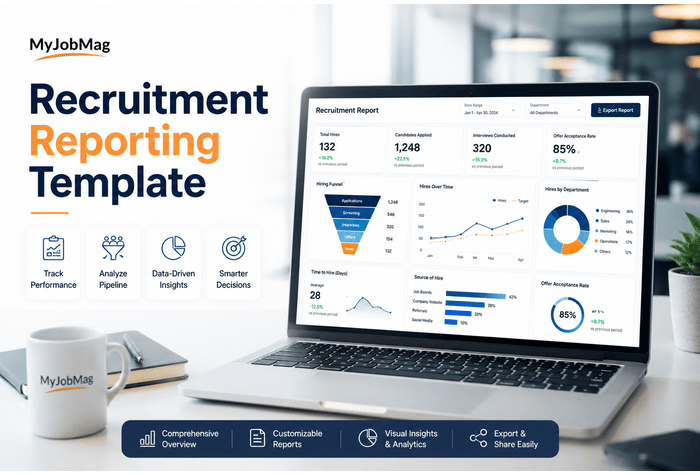
Recruitment Reporting Template
A Decision-Support Platform for Data-Driven Talent Acquisition
A recruitment reporting template designed to enable HR teams and hiring managers to track, analyse, and present talent acquisition data with speed and precision. It improves visibility into hiring performance, enhances reporting accuracy, and supports data-driven decision-making, giving organisations a clearer view of recruitment efficiency and progress.
Target Users (Who This Is For)
This recruitment intelligence system is designed for stakeholders involved across the hiring lifecycle:
- Hiring Managers: To define role requirements, evaluate candidates, and make informed hiring decisions
- HR & Talent Acquisition Teams: To manage candidate pipelines, ensure process consistency, and drive efficient hiring execution
- Interview Panel Members: To conduct structured, competency-based assessments using standardised evaluation tools
- Business Leaders / Executives: To monitor hiring performance, review key metrics, and make strategic workforce decisions
Workbook Structure
|
# |
Sheet |
Purpose |
|
1 |
Dashboard |
Executive summary of recruitment performance, including KPIs, visualisations, and hiring health metrics |
|
2 |
Candidate Database |
Centralised repository of all candidates with standardised fields, filters, and search functionality |
|
3 |
Pipeline Tracker |
End-to-end visibility of candidates across recruitment stages (application → offer → hire) |
|
4 |
Scoring System |
Structured competency-based evaluation across key dimensions (e.g., Technical, Communication, Culture Fit, Role Relevance) |
|
5 |
Interview Evaluation |
Standardised interview framework with question-level scoring and consolidated recommendations |
|
6 |
Hiring Blueprint |
Role definition template outlining must-have skills, competencies, and success indicators |
|
7 |
Time-to-Hire |
Tracks recruitment cycle time from role opening to offer acceptance |
|
8 |
Cost Tracker |
Monitors recruitment spend, cost per hire, and sourcing channel efficiency |
How to Use the System
- Define success upfront: Complete the Hiring Blueprint to establish role requirements before sourcing begins.
- Capture candidate data: Add all applicants to the Candidate Database using standardised dropdown fields.
- Track progression: Update candidate stages in the Pipeline Tracker as they move through the process.
- Evaluate consistently: Use the Scoring System to assess candidates—top performers are automatically highlighted.
- Conduct structured interviews: Record interviewer inputs in the Interview Evaluation sheet.
- Measure speed: Log key milestones in Time-to-Hire to monitor recruitment efficiency.
- Track investment: Record all hiring-related costs in the Cost Tracker to evaluate ROI by source.
- Drive decisions: Review the Dashboard regularly for real-time, executive-level insights.
Design Principles
- Standardisation: Dropdown menus and predefined fields ensure data consistency across users
- Automation: All calculations, scores, and rankings update automatically
- Data Integrity: Editable inputs are clearly distinguished from formula-driven cells
- Single Source of Truth: All insights are centrally connected and reflected in the Dashboard
- Scalability: The system is designed to support multiple roles, candidates, and hiring cycles
Key Capabilities
- End-to-End Visibility: Track candidates from application through to hire
- Structured Decision-Making: Standardised scoring and evaluation frameworks
- Performance Analytics: Real-time insights into hiring efficiency and effectiveness
- Comparative Analysis: Easily identify top-performing candidates and sourcing channels
- Auditability: Clear documentation of hiring decisions and evaluation rationale
Legend
- Headers / Section Titles: Structured navigation and key sections
- Key Metrics / Highlights: Critical insights and summary indicators
- Auto-Calculated Cells: System-generated values (do not edit)
- Editable Input Cells: User-entered data fields
- Positive Indicators: On-track or hire-ready signals
- Alert Indicators: Flags for risk, rejection, or delays
Usage Guidance
- Always complete the Hiring Blueprint before evaluating candidates
- Ensure all required fields are populated to maintain data quality
- Avoid overwriting formula-driven cells
- Use the system consistently across all roles to enable meaningful comparisons
- Review outputs collectively (e.g., via hiring panels) to support aligned decision-making