
Kenya’s labour market recorded steady growth in 2025, showing that there were more job opportunities and more active employers compared to the previous year.
A total of 41,792 jobs were published in 2025, up from 40,469 jobs in 2024. This represents an increase of 1,323 job postings, translating to a 3.3% year-on-year growth in job availability.
Employer participation also increased notably. In 2025, 3,145 companies actively hired, compared to 2,919 companies in 2024. This means 226 more companies entered or remained active in the job market, resulting in a 7.7% year-on-year increase.
The faster growth in the number of hiring companies compared to job postings suggests that more employers are hiring, even if many are recruiting for fewer roles. This points to a more distributed and competitive hiring landscape, with opportunities spread across a wider range of organisations.
This report is based on a comprehensive analysis of Kenya's job market data collected to track hiring trends and employment activity over time. The report draws primarily from job listings published on MyJobMag between January 1st and December 31st 2025, capturing real-time demand from employers actively recruiting across different sectors.
Kenya’s job market showed a clear preference for higher education, with a wide gap between degree holders and all other qualification levels. Candidates with a Bachelor’s degree (BA, BSc, or HND) dominated hiring requirements, accounting for about 60% of all job postings. This means 6 out of every 10 jobs require at least a first degree, making it the standard qualification across most industries.

Sales-related fields led the Kenyan job market, accounting for 14% of all job postings. Education, Finance, and ICT also show strong demand, driven by workforce expansion in learning institutions, growth in financial services, and continued reliance on digital and technology-enabled roles.

Between 2024 and 2025, Kenya’s job market shifted away from project-heavy hiring toward commercial, education, and people-focused roles. These trends suggest that in 2026, business growth, skills development, and digital capability will remain central to hiring decisions.
|
Job Field |
2024 |
2025 |
YoY Change (%) |
|
Project Management |
5,487 |
3,655 |
-33.4% |
|
Sales / Marketing / Retail / Business Dev |
5,220 |
5,723 |
+9.6% |
|
Finance / Accounting / Audit |
4,571 |
4,520 |
-1.1% |
|
ICT / Computer |
4,130 |
4,255 |
+3.0% |
|
Education / Teaching |
3,076 |
4,700 |
+52.8% |
|
Medical / Healthcare |
3,048 |
2,578 |
-15.4% |
|
Media / Advertising / Branding |
2,318 |
2,373 |
+2.4% |
|
Engineering / Technical |
2,228 |
2,280 |
+2.3% |
|
Internships / Volunteering |
2,043 |
2,908 |
+42.3% |
|
Data, Business Analysis and AI |
2,024 |
1,471 |
-27.3% |
|
Administration / Secretarial |
1,809 |
1,791 |
-1.0% |
|
Human Resources / HR |
1,616 |
1,595 |
-1.3% |
|
Procurement / Store-keeping / Supply Chain |
1,324 |
1,249 |
-5.7% |
|
Law / Legal |
1,064 |
1,459 |
+37.2% |
|
Agriculture / Agro-Allied |
1,014 |
1,013 |
-0.1% |
|
Customer Care |
980 |
953 |
-2.8% |
|
Research |
956 |
525 |
-45.1% |
|
Consultancy |
916 |
995 |
+8.6% |
|
Banking |
850 |
853 |
+0.4% |
|
Hospitality / Hotel / Restaurant |
748 |
836 |
+11.7% |
|
Insurance |
715 |
1,055 |
+47.5% |
|
Logistics |
677 |
537 |
-20.7% |
|
Science |
521 |
784 |
+50.5% |
|
Safety and Environment / HSE |
485 |
262 |
-46.0% |
|
NGO/Non-Profit |
451 |
187 |
-58.5% |
Accountants were the most sought-after role, making up about 15% of the top-most advertised roles. Sales and business development roles were also highly demanded. Combined, Sales Executives, Business Development Managers, and Business Development Executives accounted for nearly 23% of the top roles.

The Consulting industry had the most hiring activity, accounting for about 12% of all jobs across all industries. The Education, NGO, Government, and Banking industries equally account for nearly half of all available jobs. Job seekers targeting these industries have the greatest chance of finding employment.

Nairobi is the state with the most jobs in Kenya and is responsible for over 77% of all jobs. This makes the capital by far the most active employment hub. Job seekers looking for professional, managerial, or specialised roles are most likely to find opportunities here. Mombasa, Nakuru, Kiambu, and Kisumu also follow closely. However, these states witness a significant drop in the number of available jobs.

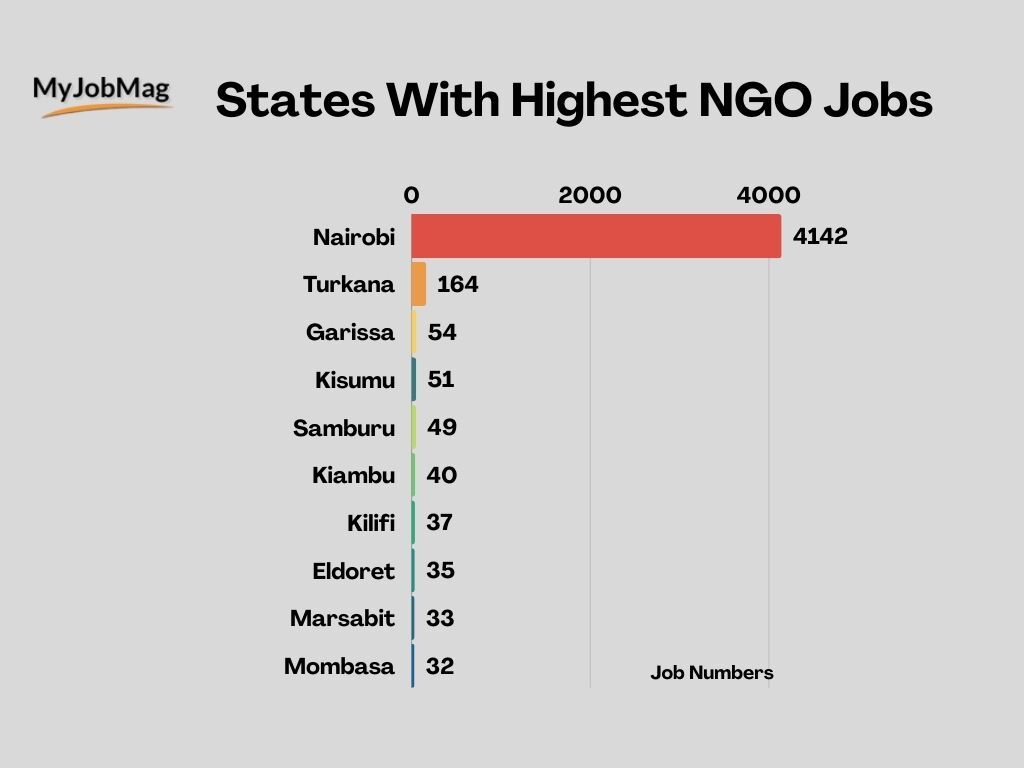
NGO hiring in Kenya declined significantly in 2025 compared to 2024, pointing to a broader reduction in international and donor-funded programs. Total NGO job postings dropped from over 7,700 in 2024 to about 4,800 in 2025, a roughly 38% decrease. Nairobi still remains by far the largest hub for NGO jobs, accounting for more than 85% of all NGO opportunities in 2025.
Remote work represents a small fraction of total job opportunities in Kenya. There was a drop of about 34% in dedicated remote roles. By contrast, full-time positions dominate the market, accounting for nearly 88% of all roles in 2025, while contract roles make up around 9%. Hybrid roles are also limited.

In 2025, Education, Banking, Manufacturing, Real Estate, and Logistics led job growth, offering the most opportunities for job seekers. Meanwhile, NGO roles, ICT, and Healthcare saw a noticeable decline, reflecting shifts in funding and organisational priorities. Emerging sectors like Building/Construction are growing rapidly, signalling new career paths for skilled professionals.
|
Industry |
2025 |
YOY (%) |
|
Consulting |
5,611 |
+5.2% |
|
Education/Teaching |
5,442 |
+41.2% |
|
Banking/Financial Services |
5,310 |
+33.1% |
|
NGO |
4,851 |
-33.4% |
|
Government |
4,794 |
+16.2% |
|
Healthcare/Medical |
2,532 |
-9.9& |
|
ICT/Telecommunications |
2,288 |
-16.8% |
|
Manufacturing/Production/FMCG |
1,595 |
+48.2% |
|
Insurance |
1,211 |
+20.1% |
|
Hospitality |
985 |
-13.3% |
|
Engineering/Technical |
875 |
-4.7% |
|
Agriculture/Agro-Allied |
790 |
-1.7% |
|
Logistics |
594 |
+36.9% |
|
Real Estate |
526 |
+52.6% |
|
Power/Energy |
456 |
+9.3% |
|
General |
420 |
-28.8% |
|
Media/Radio/TV |
385 |
-6.8% |
|
Sales/Retail |
306 |
+30.8% |
|
Aviation/Airline |
253 |
-12.2% |
|
Pharmaceuticals |
242 |
+3.9% |
|
Internet/e-Commerce |
226 |
-37.6% |
|
Building/Construction |
184 |
+776.2% |
Kenya’s labour market is expected to remain resilient but selective. Hiring will continue to favour commercial, skills-driven, and revenue-generating roles, particularly in Banking, Manufacturing, Logistics, and Real Estate.
NGO and donor-funded roles are equally expected to remain below their 2024 peak, reflecting tighter global funding conditions.
Geographically, Nairobi will continue to dominate job creation, though secondary cities such as Mombasa, Nakuru, Kiambu, and Kisumu may see gradual growth.
Nevertheless, job seekers should focus on building relevant skills and qualifications aligned with high-growth sectors, while combining academic credentials with practical and digital competencies to remain competitive.
Employers are also encouraged to use labour market data to guide their workforce planning.
Universities and training institutions, on the one hand, should continuously align curricula with labour market demand. Policymakers, on the other hand, should prioritise policies that support job creation in high-growth industries, as well as promote regional employment beyond Nairobi.


Hello, we are a team of experienced recruiters and we are happy to help you recruit your next team member.
Contact Us
Excellent report! Two things stand out for anyone job hunting in 2026: First, the 'Degree Gap' is real—60% of roles still prioritize formal degrees, but the 42% growth in Internships suggests employers are increasingly looking for hands-on experience to bridge the gap. Second, with 77% of jobs concentrated in Nairobi, the 'Silicon Savannah' remains the heart of the market, but the growth in secondary cities like Kiambu and Nakuru is a trend to watch for those seeking a better work-life balance
This article gives a great overview of the current job market in Kenya.
With sectors like IT, finance, and hospitality growing, opportunities are expanding fast.
Job seekers should focus on building relevant skills and staying consistent.
Online job portals make it easier to discover new openings daily.
I’ve personally found useful listings through www.kenyajobsearch.com.
It’s a reliable platform for fresh jobs in Kenya across industries.
Definitely worth checking regularly if you’re actively applying.
Consistency combined with the right platform really pays off.
Im interested in getting one of the jobs and am sure I will get more ranks and also get to learn more Abt the jobs